Despite morning sun flooding through the tall, south-facing window, the room gave an impression of darkness. It seemed to belong to the past. A lute and mandolin, stained by tobacco smoke and cracked by central heating, hung from the only wall not lined by shelves of books. These, I noted, were mostly cloth-bound, or with the sort of barely clinging-on dust covers you might find in the antiquarian corner of an Oxfam bookshop.
Perhaps I lost myself, staring at them.
‘You’re a reader?’
The elderly woman I was visiting smiled at me. I was supposed to be offering her an assessment relating to various small services from the charity I worked for.
‘I’m sorry,’ I said. ‘Beautiful old books are my catnip.’
‘That’s rather obvious.’
She continued to smile and, ridiculously, I blushed.
‘There are worse obsessions,’ she murmured.
We returned to the task in hand, but when I rose to leave she got up too, shuffling purposefully across the carpet to pick out a thin volume bound in faded red cloth, with a crimson tassel for a bookmark.
‘Perhaps you might like this.’ She held it out to me. ‘It’s long out of print I’m afraid.’
‘Thank you, Mrs Tripnort,’ I said, instinctively kneading the textured cover between my thumb and forefinger.
Strangely, perhaps uniquely considering his death in the nineteen-seventies and lifetime of near obscurity, this was how I came upon the flaneur, self-described minstrel, and author of London Sighs Itself Awake, E.F. Tripnort. Some writers seek anonymity, most find it thrust upon them. But it would become clear that E.F. Tripnort was by choice avoidant of anything you might think of as public recognition.
Something about the title – I have always thought of London as a collective spirit – made me quit the biography I was reading and turn instead to Tripnort. His book was a curio, one of those novels you think must really be memoir: idiosyncratic, personal, and assuming the reader’s indulgence from the first page. It had a male protagonist, no particular chronology, and no evident plot. Returning for a moment to the copyright page, I realised I was holding a first edition. Only edition? The publication date was nineteen forty-seven.
Reading on, I began to detect a theme of dispossession: the narrator, unnamed, but whom I soon thought of as Tripnort, somehow distanced from his immediate circumstances. After a short preface he sets out radially across the country, conjuring imagery, quoting Blake, always preoccupied by a London he remembers, uncrushed by bombs, intact in spirit. He goes on foot, sleeps where he can, and at the end of each chapter returns to the reality of a bruised and reeling city.
I quickly realised that Tripnort was an example, perhaps a last example, of a truly English writer. He was of a generation that had not yet learned to apologise for the fact of its Englishness. On his travels he describes a country in need of redemption, not from what it has become, but from those things he perceives it has lost. He writes as though it is a microcosm of the entire world.
I began my search before I had finished the book. It’s a rare public figure who can totally elude Wikipedia, but so it was with Tripnort.
Undaunted, I began to examine the indexes of contemporary biographies. Occasionally his name would appear in a footnote, or tagged on to a list of slightly less forgotten figures. In one tantalising paragraph he was passingly described as a visionary by Graham Greene.
I could understand. Where others might see broken churches, Tripnort speaks of chapels of light. A bedraggled market square might be rendered as a portal to a lost arcadia. He seems to believe in the risen dead, or reincarnation, or even in the presence of those who had once lived, but not quite gone away. I wondered who he had lost in the war.
I’m sorry if this sounds vague or insubstantial. Tripnort did not give the impression he thought his musings definitive, and yet they were strangely convincing. His was a world of inference and symbolism, which made me wonder how many readers would ‘get’ him, or even if he’d ever really wanted to be got.
On his travels he carries a mandolin or lute. I remembered those instruments hanging on Mrs Tripnort’s wall, and felt a swelling in my throat. He sings, often unheeded, on street corners, hoping to make enough money to feed himself. In summer, rambling through Kent, he spends a few weeks hop-picking. He builds dry-stone walls in Northumberland. He works as a ferryman on the Sussex Ouse. Always he returns to London as if returning to his heart. Coming to see it afresh, he begins to imagine its resurrection.
Tripnort is, in the literal sense, reflective, a mirror of each circumstance in which he finds himself. Though no active service is mentioned, the war has left him with a residue of despair. I quote: ‘Is the gradual depletion of happiness, sneaking anhedonia, the same as misery? I suggest not. Misery, as I have known it, is a dynamic state. The absence of anything you might call joy is more like finding oneself waist deep in a relatively tolerable quagmire. I will return to this later.’
He does not return to it, and I began to sense a book untouched, or at least indulged, editorially. Even so, as I read on, it continued to spin its web. I couldn’t believe I was the only reader to be caught in it.
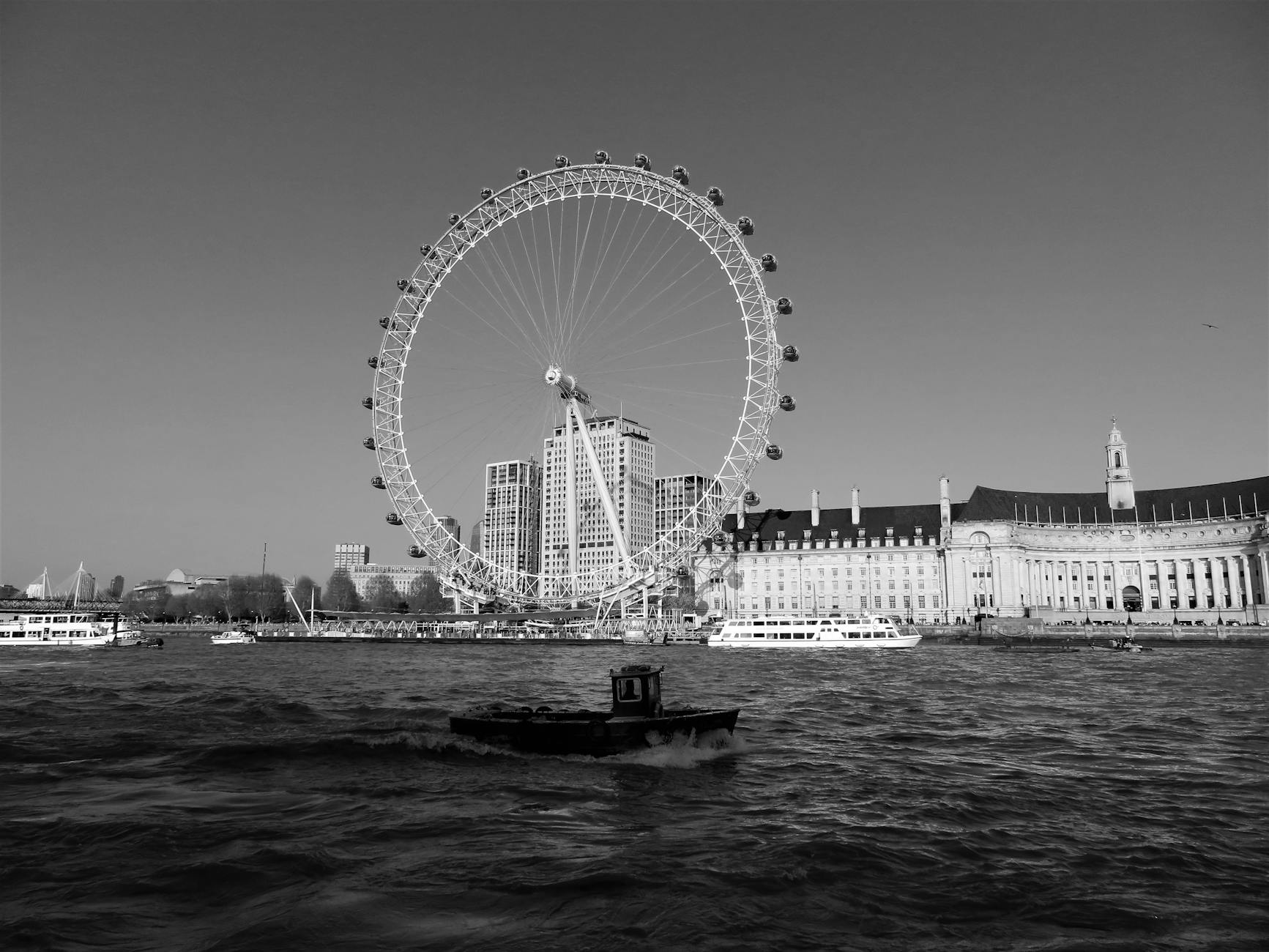
On his final journey, Tripnort is recovered from a ditch, not far from the river Wye. Carried by cart, apparently delirious, to a nearby farmstead, he is treated with kindness. As consciousness returns, he discovers that he has whispered about clusters of silver buildings, dwarfing St Pauls, their peaks tickling the clouds. Then a vast Ferris wheel, standing by the Thames, to be replicated around the world. Then of fire that would again descend on London, but now not from the sky. And finally a time when suffering would yield to celebration, before merging into a future that was no more or less than the simple ebb and flow of life.
And there the book ended. I sat stunned, overcome, struggling to believe what I had read. These were the words of a seer, a man apart, a sage visited by premonitions anyone might recognise. I had to know more.
The charity I worked for would deem Mrs Tripnort a vulnerable elder. Visits for anything other than official business might result in discipline, or even the sack. But I had obeyed too many rules in my life. I found Mrs Tripnort’s file, noted her details, and phoned her.
‘Of course you may come,’ she said. ‘He was an intriguing man. I’ll do my best to answer your questions.’
The following Saturday morning I made my way to her flat in Erdwell Street, on the north edge of what was once old Soho. When I arrived, Mrs Tripnort had prepared coffee and, the day being rainy, her living room was even darker than I remembered. She poured, folded her hands in her lap, and raised her eyebrows in invitation for me to begin.
‘The book’s structure is intriguing,’ I suggested. ‘Was it a conscious decision to keep setting out, but return to London as a focal point? I’m assuming the narrator is drawn from E.F. Tripnort himself.’
‘You’re correct in that assumption, and please, let’s refer to him as Eric. He had a habit of going off, but then I knew he would. I had a habit of conducting short trysts in his absence, but then he knew I would. We understood one another and it worked for us. In that sense it was a conscious decision. But regarding the structure, I don’t think he had a book in mind from the outset.’
‘Then the idea grew from his travels? I take it he was a Londoner?’
‘None more so. There were generations of the city in his bones. His father was a drayman, and the men on his mother’s side were Thames lightermen or dock workers. Eric might have been too, had it not been for the Working Men’s College. You could see his ancestry in everything about him. He had the hands of a navvy – a pen looked tiny in his grasp.’
‘How strange. I’d visualised him as a small man.’
‘You’re correct in that too. His hands and feet were disproportionate.’
‘He clearly had a sense of the numinous. Where did that come from? Were his family religious?’
‘Not in any formal sense, but those I got to know managed to combine free-thinking with respect for the traditions they’d grown up with. Eric had something of that in him, plus an innate singularity that the others could recognise. “Our Eric’s different”, you might sometimes hear them say.’
‘And he attended the Working Men’s College – as a mature student, I assume?’
‘Yes indeed. His love of study set him apart too.’
‘What subjects did he study?’
Mrs Tripnort glanced over her shoulder to indicate the lute and mandolin.
‘Music initially, then literature, then philosophy.’
‘Oh, so music drew him into further education. What was his interest in it?’
‘At various times he’d call himself a balladeer, troubadour, or minstrel. He wrote songs about things that attracted his attention. Topical, you might say. He had also heard that Laurie Lee took a fiddle with him on his travels and made some money busking. Eric was not entirely without pragmatism.’
‘And what about the war? You can feel it on every page, but he doesn’t write about his part in it.’
‘All I will say is that there were some rather significant people at the Working Men’s College when Eric attended. It was noticed that there was something unobtrusive about him – you might call it something of the everyman, although that would only illustrate how misleading one’s outer self can be. That quality was put to good purpose during the war, and later he put it to good purpose too. I believe he realised that going unnoticed could be an asset. I also think it appealed to his temperament.’
We were silent for a few moments, and then Mrs Tripnort added, ‘But in answer to your earlier question, like many who had been through the war, thereafter he was apt to see mundane existence as a form of marvel in itself.’
‘A bit like Stanley Spencer in Cookham?’
‘How perceptive of you.’
‘But I read the book as a search for things lost, for things he valued that had been destroyed.’
‘And so it was. The book he planned next was to be called The Redemption of the Ordinary.’
‘He planned another book? What happened to it?’
‘His breakdown, after which he joined an enclosed order.’
‘He had a breakdown then became a monk?’
‘Not a monk, a handyman. It was an unusual arrangement, though not unprecedented, I understand.’
‘But what caused his breakdown?’
‘Perhaps you’ve read how John Clare could grieve for a single tree? Eric was like that with buildings, landmarks, everything. London was a map of his spirit. Ultimately he was overwhelmed by its degradation.’
‘But surely he’d begun to see hope? The very title London Sighs Itself Awake implies a new beginning.’
‘In some circumstances hope can be as painful as despair.’
‘Then, forgive me for asking, but did your marriage end at that point? It sounds very sad for you both.’
‘The monks were surprisingly accommodating. I was allowed to visit. And, perhaps because he was of such practical use regarding the running of the place, conjugal activities were discretely overlooked.’
‘My god – and you were okay with that?’
‘I adapted. I never expected life with him to be ordinary.’
‘But didn’t he feel restricted? He was used to travelling, to observing. It must have been a deprivation to be so confined.’
‘You’d think so, wouldn’t you? But the monks indulged him in other ways. Every now and then he would wander off, usually to London, but he was always readmitted.’
‘Then could you say he was happy?’
‘Happiness is a relative term, don’t you think? What I mean is, it’s possible to survive on a store of previous happiness, until the day comes when you must admit it has finally expired.’
I wasn’t sure what Mrs Tripnort meant by this, but thought again of the war and its aftermath. My glance strayed to the lute and mandolin, both probably unplayable now, and then to the many rows of books in that dark room that spoke of a receding era. For a few moments I felt carried back in time, and then realised Mrs Tripnort was smiling at me. The skin round her eyes crinkled with kindness, and she spoke quietly.
‘Don’t be sad for him, or me. Life is what it is, and we must all pay for the person we have been. Eric lived with a heightened sensibility, and he paid for that.’
‘He paid for being so conscious of the world around him?’
‘Yes, I’m sure. His awareness was a gift and a burden. When you spend years with someone who sees life so vividly and relentlessly, you realise how exacting such an existence must be.’
‘Then do you think the book contributed to his breakdown? That it brought up all the things he saw and thought about, and in the end that in itself was too much?’
‘You could be right. But he had a surprisingly practical side he was able to fall back on.’
‘In a place that gave rest to his spirit?’
For a few moments Mrs Tripnort gazed down at the worn Persian carpet, then again spoke quietly.
‘Not rest, I think. Containment, perhaps, until the next phase of his life, had that transpired.’
I noticed she had begun to look weary, and for the first time a little sorrowful, so after thanking her profusely I stood and saw myself out.
It took a minute or so to adjust to the late morning sun, then, as my eyes adapted, I was overtaken by a curious sensation. I could feel Tripnort’s ambience everywhere: in the London pavements beneath my feet, in the buildings that had grown like seeds from bomb sites, in the air no longer tainted by nineteen-forties smog. It was as though, for a few moments, I was inhabited by another consciousness, ineluctably part of everything around me, as it now was, but also as it once had been. And then the feeling drifted away, leaving me, not bereft or even confused, but hollow with longing for an unremembered way of being in this world.
About the Author
Mike Fox’s stories have been nominated for Best of Net and the Pushcart Prize, listed in Best British and Irish Flash Fiction (BIFFY50), and included in Best British Stories 2018 (Salt), His story, The Violet Eye, was published by Nightjar Press as a limited edition chapbook. His new collection, Things Grown Distant, featuring photographic illustrations by Nicholas Royle, is available from Confingo Publishing www.polyscribe.co.uk