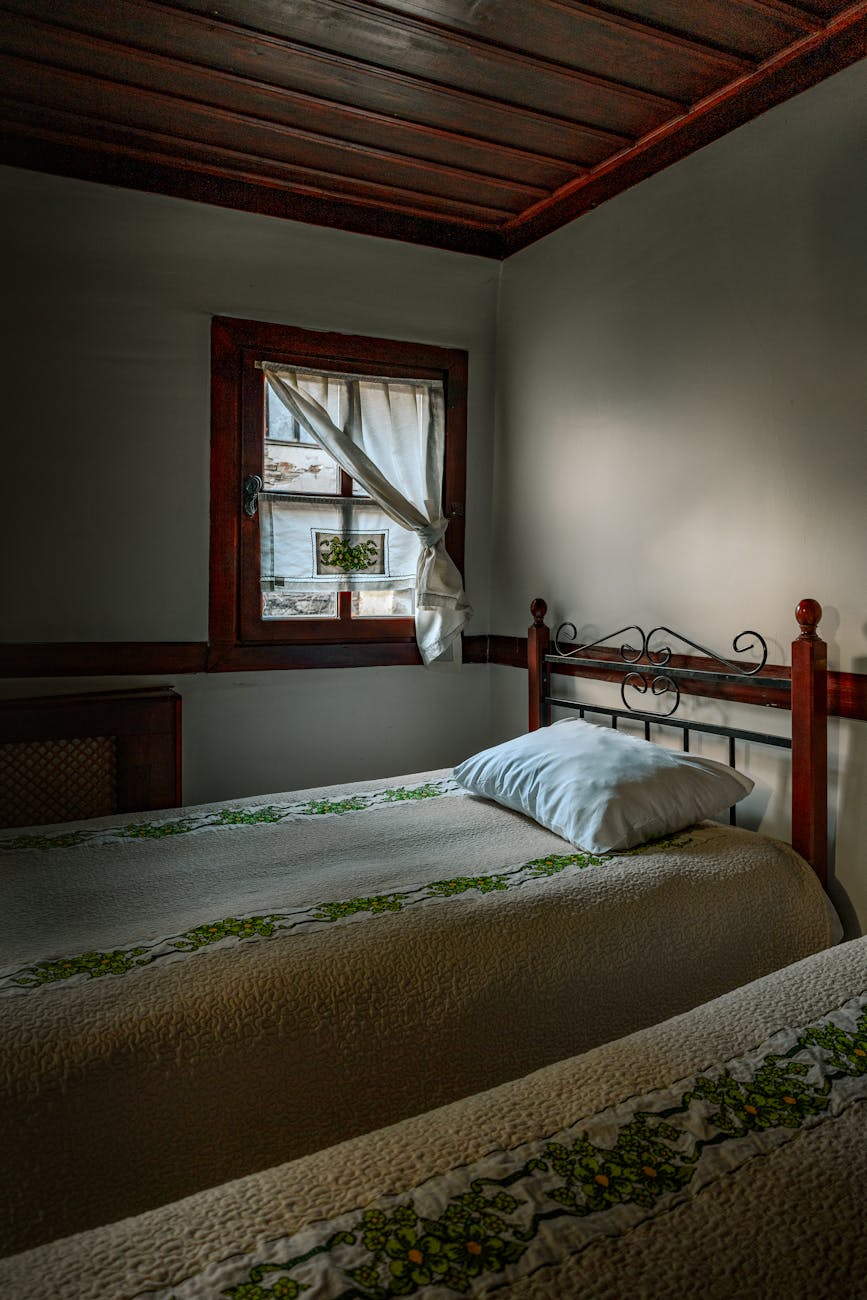
I think Ellen’s still asleep. I trace her profile with my finger: that set-square nose, those lips still smeared with yesterday’s lipstick, the lipstick that office work requires – City Lights, Cranberry Ice, or Cherry Jubilee – so many colours nowadays. As I reach her breasts her eyelids flicker open.
“Hi,” I say, “I didn’t hear you come in last night.”
“Crap office party. Dragged on for ages, but in my position, I couldn’t leave could I.” She rolls to face me, raising herself on an elbow, “Steve, I saw a UFO. I tried to wake you last night but you were out for the count. It was at the top of the hill over the reservoir. Blue lights. It got closer then sort of shuddered into pixels and whizzed off.”
“Do you want breakfast?”
“Ok, I see a spaceship from another dimension and you go on about fucking breakfast? Gimme some respect.”
She jumps out of bed, pulls on her jeans, right leg first as always.
“Where are you going?”
“I want to see what the TV’s saying about last night. Nothing was on Facebook but I’ve never trusted that anyway. It’s the dawn of a new era for humanity. Don’t you want to be part of it?”
“Look Ellen, I know your work’s been stressful, but -“
“But you can shut the fuck up,” she says, storming out.
It’s going to be one of those days. She’s losing it, but if I tell her, I’ll lose her, and it’s her house, bought with her parents’ money. I pull my knees to my chin and hug them. I know what each sound funneling up the staircase means – the click of the kettle, the scrapes as she turns the jam-jars of herbal teas on the window ledge one by one to read their handwritten labels, the unscrewing of a lid – “Autumn Whispers” maybe. I can imagine the teabag falling into her gold-rimmed tea-cup. She takes a spoonful of sugar, taps it on the bowl to level it, tips it in. Then again. A pause (she’s supposed to be on a diet), then another spoonful. While pouring in the water, she stirs. She starts thumbing the top off the biscuit tin, turns it, thumbs again. There’s a cymbal crash as the lid hits the floor. She picks out her favourite Hobnobs, drops them onto a dish, carries everything to the table, flicking the cupboard door closed with her hip as she passes. Then she switches the TV on.
I wait until I’m sure she’s not returning, then get dressed and go into the spare bedroom. I place my notebook on the desk, choose black on my multi-colour pen and place it carefully beside the empty page. Then I go down to patch things up, or at least get breakfast – I’m starving.
“The ignition’s gone again on the rings so you can forget porridge,” she says, channel-hopping.
“Cornflakes will do,” I say, shaking the packet for emphasis before filling a bowl.
I look out of the window. Grey and still, perfect weather for a winter walk. The lawn’s a tangled mess. When we got the mower out for the last time before winter, it wouldn’t start and we didn’t bother fixing it. Slap in the middle of the garden is an old swing that the previous owners left behind, their kids grown up. Back in summer Ellen swayed on it for hours, reading, until I called it her mood swing. Not one of my finest moments – if she falls apart, what chance have I got?
She wolfs down a biscuit. I scoop a spoonful of cornflakes.
“I’ve got it!” she shouts, “Christmas!”
“So?” I’m worried she’s going to tell me off about not buying presents yet.
“He’s come in a spaceship this time.” She hums The X Files theme tune. “OK Mulder, wudda we do now? Pray that he can do miracles with hot-plates?”
She seems in a better mood. I shovel more slowly.
“Want some tea?” she asks.
“I’m ok.”
“Because if there’s anything else I can do for you, anything at all, you know you only have to ask.”
“I’m ok, really.”
“We’re going to have to talk about this you know. Really talk. Item one on the list, and there’s only one item.”
I add my dish to the pile in the sink, picking up the biscuit tin lid as I go, leaving it on the table.
“In a rush?” she asks.
“I’m going for a walk and may be some time.”
“You always get pissed after we argue. I’m surprised you’re not an alcoholic. Doesn’t do your sperm count any good you know. You’ll be in single figures soon. Negative even.”
I put my shoes on.
“Anyway,” she continues, “don’t worry about me. I’ll just do some phoning around. Look on the bright side, Steve, at least I wasn’t abducted. I promised to keep my knickers on last night and I did.”
“Bye,” I say, careful not to slam the front door.
It’s a routine we’ve fallen into – me taking the blows to stop her hurting herself, then going out to recover. The streets are deserted. We should never have come here. We moved because of her job, but we left a lot of supportive friends behind. We moved because we’d hoped our old flat would soon be too small. Now our house is too big. We can wander in it, not knowing the other is there. What can I do? One: I mustn’t buy a half bottle of vodka in the corner shop. Two: For Christmas I’ll get her a garden hammock and a telescope. Three: I mustn’t argue back.
When she’s away at work, I’m supposed to write. That was the agreement. And writers have to read even though it doesn’t look like work. I’m currently reading “Tell Her You Love Her” by Bridget O’Connor which I found for a quid in a charity shop. I hadn’t heard of the author but it’s a story collection so I bought it anyway. There are fifteen stories, each ten to twenty pages long. Several of the first-person characters are unsuccessful with the opposite sex. They don’t see their current job (in a shop or factory usually) as permanent. They have artistic aspirations. They’re hoping that something will come along. They are difficult characters to love. When they meet someone they fancy it’s unrequited.
People say that you should echo and mirror a difficult person’s actions to reduce their hostility. Some of the characters try this tactic. However if the difficult people turn out to be narcissists, mirroring merely reinforces their behavior. They create masks, false selves. When their narcissism’s cured, the false self doesn’t die, it becomes a detached self, or a story.
Most of her main characters are women in their twenties, beginning to worry about their weight. I shouldn’t feel any empathy with them, yet I do. An event (a parent dying, an eviction, etc) stirs them from their routine of trying to find themselves. It doesn’t matter if they’re inarticulate because at pivotal moments the author speaks through them to make sure that we don’t miss the point. I wish I had another person speaking for me. I empathize with the author who shows through, her years of drifting and hoping, waiting for the big break. For her it came – she had a book published. Some of us aren’t so lucky.
She died of cancer in 2010, aged forty-nine. She was married to Peter Straughan, who she wrote the screenplay of “Tinker Tailor Soldier Spy” with. Her husband, by then a widower and single parent, had to give acceptance speeches for the awards their screenplay received. Her books aren’t listed on her Wikipedia page. I guess once she broke into films, she didn’t care about her books. But I care. You’ll find my review of her book on Goodreads. 3 stars was a bit mean.
Perhaps I’m a narcissist. Maybe writers have to be. I’m writing short stories having failed with novels. In my twenties I drifted, hoping that something or someone would come along and save me. Ellen accepted my oddities and I accepted her. I should count my blessings. Nowadays a drink can get me through difficult times – breakfast for example, when I’ve woken with a sad song in my head that won’t go away, and Ellen’s left for work. I’m unsure what comes first, the song or the sadness. Take Roy Orbison for instance. He always had the voice. The image (dyed black hair, black sunglasses, black guitar) came later. People thought he was blind, but he was just shy. Songs like “Only the Lonely” came before his wife left him for a builder then died on a motorbike. Then two of his sons died in a house fire.
Surely sadness comes first. We came here to this house so I could have a spare room to write in, make a name for myself. She was going to support us until I got established. I realise now how crazy that idea was. We were both mad. Writing about my failure’s not the answer.
I reach to the corner shop that’s always open. The food outside’s in so many shapes and colours that I don’t know what’s fruit and what’s vegetables. I walk up and down the narrow, tall aisles, checking the crowded shelves, giving Ellen a chance to cool off. At the counter I point behind the head-scarved cashier – “Can I have some matches?”
“Is that all?” she smiles, putting the pack between us. I notice a pile of local papers beside her. Maybe it’ll have something to explain the lights Ellen saw. I slide the top copy onto the counter.
“Let’s splash out,” I say, smiling back, but as she hands me the change her eyes are already scanning the other customers.
Outside, the cold surprises me. I wasn’t cold before. I think of how Ellen wraps each item that she returns to the fridge as if it’s about to be re-sold; how she strokes the curtains smooth after opening them, running her hands down the folds; her lists of things to do, random at first, then she puts a number by each item and rewrites them in order of priority. When you marry someone you marry their habits too. Even after their mind goes, their habits remain – her breakfast routine and my writing preparations. Love clings to those habits. We could carry on like this for years, through boom and bust. When there’s too much order in her life something bursts in – line-dancing, detox and now UFOs. Who’s going to pick up the pieces if I can’t cope anymore? We’d be like two jigsaws whose pieces are all jumbled up. I’d better get back before she phones the press. We could go for a walk to the hill. I could show her how the city lights reflect strangely off the lake and the low clouds.
I realize I’m still clutching my change. I pocket it and start jogging. I’ll say sorry again, put the matches on the kitchen table. “I got them just in case we’d run out,” I’ll say, and she’ll pick the box up, hiding it away while I go upstairs to write.
Tim Love’s publications are a poetry pamphlet Moving Parts (HappenStance) and a story collection By All Means (Nine Arches Press). He lives in Cambridge, UK. His poetry and prose have appeared in Stand, Rialto, Magma, Fragmented voices, Unthology, etc. He blogs at http://litrefs.blogspot.com/
X: @TimLoveWriter
Facebook: www.facebook.com/tim.love.315
Instagram: @timlove136